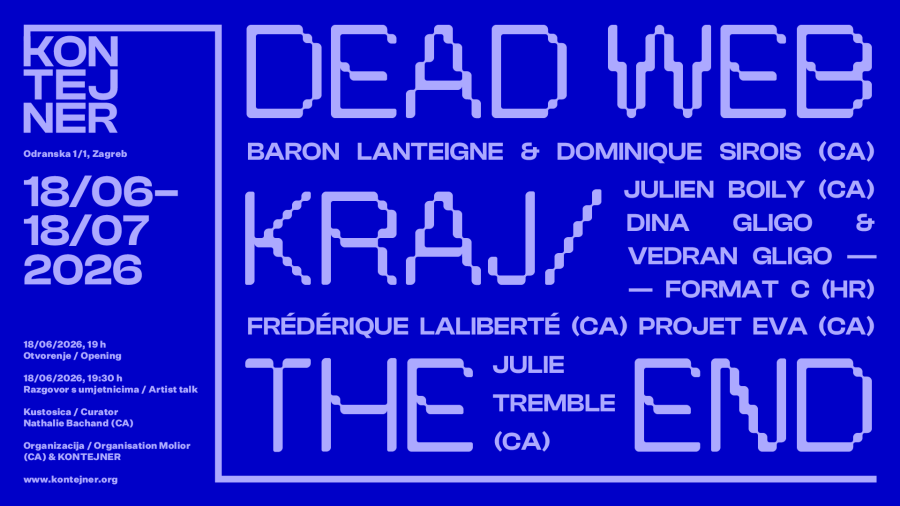
This exhibition was first presented in 2017. Nearly ten years later, the face of the Internet has changed considerably. The presence of artificial intelligence (AI), in particular, has intensified: by 2024, bots had surpassed human activity online; generative AI actively contributes to misinformation; and advertising algorithms are persistent, even harassing. The promise of liberation that the Internet once held now resembles a form of more or less voluntary enslavement, and our desire to step away from the connected screen is almost proportional to our near-daily obligation to use it. This sentence “How the email found me,” and the accompanying images—which have spread through countless memes—aptly sum up our current relationship with Internet culture and the overwhelming hyperconnectivity that comes with it. What if, someday, these emails stopped finding their way to us…?
-
It all began in May 2015, when an article on lemonde.fr suggested the possibility of a collapse of the World Wide Web. Although this event is largely hypothetical, several articles have been written on the subject in response to a scientific symposium that the Royal Society organized around the Internet Capacity Crunch.
In a context where the network could abruptly collapse, we can try to picture the fall of the Web and the afterworld that would ensue: Empty server carcasses and a sea of electronic junk? A digital oblivion on all screens? Machines imitating the Web? A handcrafted Internet? How will the at once dematerialized and delocalized dynamics of power structures be impacted in both their evident economic and inevitably political manifestations if the network is disconnected? But also, what can still be said or done in the meantime? How does one occupy—or not—what is essentially borrowed time and space, a space-time henceforth to be shared between digital and physical realities?
In the wake of these reflections, artistic proposals that echo these considerations have been gathered. Originally featuring artists from Quebec, this exhibition also includes, for this occasion, a duo of Croatian artists. Altogether, these artworks offer a particular perspective, building and unpacking our idea of the Web, and its absence, at the same time.
- Nathalie Bachand, curator
"The Dead Web - The End" was presented for the first time at the Eastern Bloc artist-run center in Montreal in January-February 2017. After this first independent iteration, the exhibition was produced by Molior and shown at the Mirage Festival in Lyon (France) in April 2019, and then at the Mapping Festival in Geneva (Switzerland) in May-June 2019, and finally at the Ludwig Museum – Museum of Contemporary Art in Budapest (Hungary) in January-April 2020.
The works in the exhibition question our relationship to the Internet and, more broadly, the notion of connection as a point of contact with the world. The exhibition is trying to engage the audience in presenting the post-internet world. In this new presentation at KONTEJNER, the exhibition includes two new works: "Pivilion/EXEno1: TOGETHERTOGETHER" by Croatian artists Dina Gligo and Vedran Gligo – Format C, and "Infinitisme.com: FINAL NOTICE" by Frédérique Laliberté, a sculptural and sound installation created especially for the show from the material and virtual debris of "Infinitisme.com Forever A Prototype", that was presented in previous editions of the exhibition,
IMPRINT
Organization: Molior & KONTEJNER | bureau of contemporary art praxis
Curator: Nathalie Bachand
General and artistic director of Molior: Aurélie Besson
Administration and production: Marta Gaspar Carpinteiro (Molior)
Technical direction: Camille Desjardins (Molior), Jakov Habjan, Ante Alilović
Design: kuna zlatica
PR and social media: Juliette Demers-Cyr (Molior) & Inesa Antić