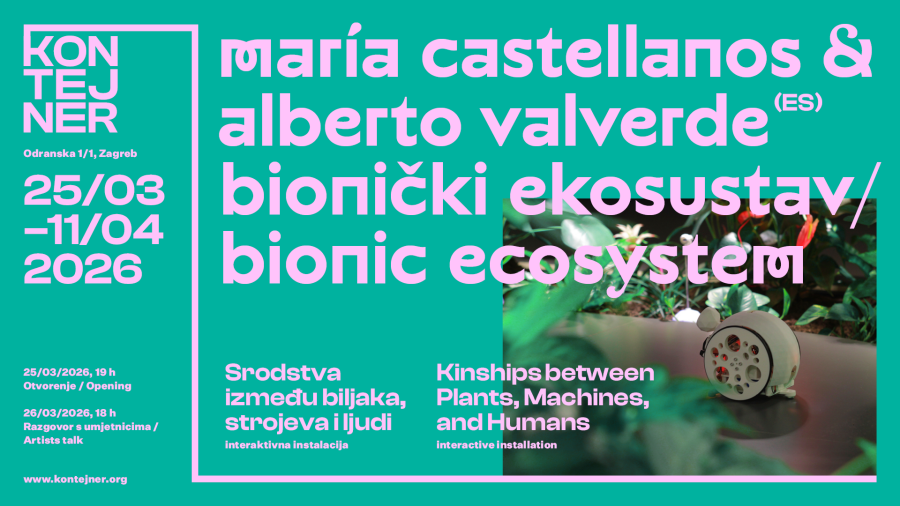
Imagine a future in which humans, plants, and machines can coexist and learn from one another—a future not based on the separation of humans from other living beings, but on a vision of coexistence and interconnectedness, in which the human species is an integral part of the biotic community rather than its manager. Imagine cities of the future that breathe like forests, where buildings adapt their outer skins through sensors to daily conditions of light and humidity, in order to optimize, like plants, various morphological mechanisms of preservation and self-sustenance. Or plant roots that communicate with global data networks, translating the conditions and state of the soil in which a plant grows into signals that machines can read and further process. Or machines that learn from ecosystems that have existed and thrived for millennia in their immediate surroundings.
In such an envisioned future, humans become equal and considerate participants who learn about changes in living nature on micro and macro levels, becoming aware of forms of knowledge and intelligence inherent to other living organisms and species, and recognizing how essential the interconnectedness and interdependence of living beings are for ecological balance. Accordingly, they shape the spaces they inhabit. Machines, on the other hand, can extend existing natural patterns, helping to restore damaged landscapes and support new forms of biodiversity.
Such visions are not merely a distant future, but, on a certain speculative level, already very close concepts and possible developments. Various research methods also enable contemporary artists, through scientific experiments and technological innovations, to gradually approach such a future and, through their visions, open space for a deeper understanding of symbiotic relationships.
Research on plant intelligence, such as that conducted by the Italian botanist Stefano Mancuso, has shown that plants can perceive, learn, and adapt. Spanish artists María Castellanos and Alberto Valverde, working under the collective name uh513, explore these capacities beyond the field of biology in their new interactive installation "Bionic Ecosystem: Kinships between Plants, Machines, and Humans", emphasizing that plants learn not only individually but also in relation to robots that interact with them and with humans.
The installation "Bionic Ecosystem. Kinships between Plants, Machines, and Humans" investigates new forms of communication between living organisms and autonomous artificial agents. Using plant electrophysiology sensors, the installation records the electrical activity of living plants and transforms these signals into data that feed a network of autonomous robots. Through machine learning, the robots interpret the plants’ electrical responses and decide how to interact with them. Some robots use light, some use sound, while others communicate through gentle touch. These stimuli affect the plants’ physiological state, altering their electrical activity, so that plants influence robots and robots influence plants. Over time, the installation develops into a hybrid ecological system of interspecies learning between plants and machines, as well as visitors, who become part of this living network upon entering the exhibition space.
María Castellanos and Alberto Valverde have created a space of speculative coexistence in which all participants influence one another and learn from each other. The interactive installation "Bionic Ecosystem. Kinships between Plants, Machines, and Humans" envisions new forms of coexistence on Earth, within a shared space where art, science, and philosophy converge to explore possible futures beyond anthropocentrism.
IMPRINT
Organization: KONTEJNER | bureau of contemporary art praxis
Curator: Tereza Teklić | KONTEJNER
Technical realisation: Jakov Habjan
Design: kuna zlatica
PR and social media: Inesa Antić