EMAP residency 2020
This year's EMAP residency started beginning of April. Although it was initially planned that María Castellanos and Alberto Valverde conduct their research in the biotechnological laboratory of UR Institute under the guidance of Gjino Šutić, due to the global pandemic the production of their work „Beyond Human Perception“ is continued in the artists’ studio in Spain, with weekly online meetings with the curators from KONTEJNER. Part of the residency will be held in collaboration with LABoral Centro de Arte y Creación Industrial, Gjión, Spain. The goal of the EMAP residency is to offer artists better conditions and resources for the research and production development of art works. The focus is on cross-sectoral and interdisciplinary aspects of art works development and the possibility for an intensive and focused artistic research. The residency contributes to international visibility and significance of contemporary artistic practices engaging local communities and new audiences, merging productively and creatively diverse areas of knowledge.
Beyond Human Perception, 2020
“Beyond Human Perception” is a work that researches the relationships between human beings and plants and the response of both living beings to a common stimulus – live music.
Plants are living beings that are found all over the world, sensitive to their surroundings and sometimes bypassed by human beings. During recent years, plants have had an active part in uh513’s artistic practice. They created artworks in which they tried to understand the secret language of plants and achieve a better understanding of the world of vegetation. uh513 developed a sensor to measure electrical changes in plants in real time and noticed that plants react instantaneously to changes in their surroundings, such as changes in light, humidity, air movements, CO2, the presence of other living beings and sound.
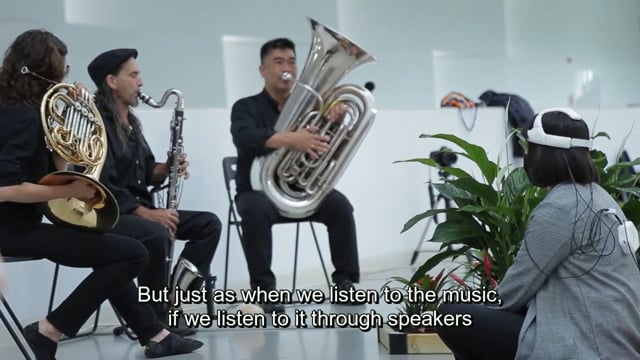
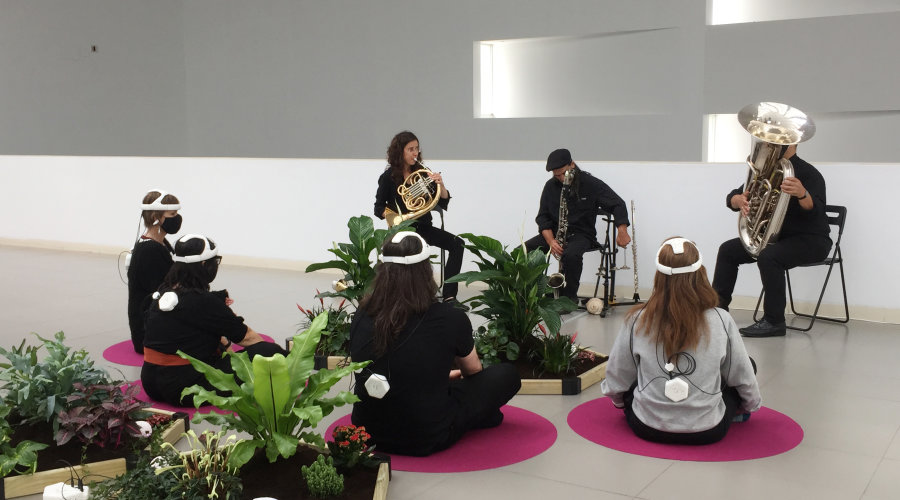
During a recent experiment, that they carried out in the framework of an artistic residence that was developed in the context of the FELT – Futures of Living technologies project at OsloMet University, they could observe that plants and humans react in a synchronized way when a person interacts with a plant. This fact was the turning point of the present project, in which María and Alberto want to observe how plants and humans react to a common stimulus – live music. It is accepted that plants react to different frequencies that can be found in nature, but what happens with music? Music has been inherent to human development, and we know that it affects the brain chemistry. So, the experiment that uh513 wants to develop consists in establishing a controlled space, where they will place people and plants, both listening to live music.
In this way, they will explore the relationships between the sound stimulus and physical reactions by registering the reactions in humans, measuring their brainwaves and by recording electrical oscillations in plants, as a reference point to the plant’s behavior.
By comparing the reactions in human beings and the reactions in plants they will create a link which brings us closer to the world of vegetation, a world not quite different from the human world but much less known.